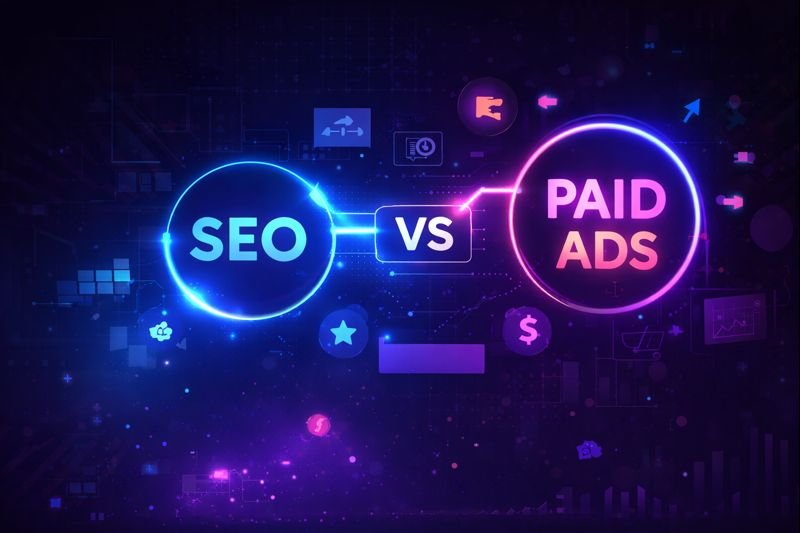
“Should we invest in SEO or in paid ads?” is one of the first questions business owners in Puerto Rico ask us. The honest answer is that they solve different problems. Paid ads buy attention today. SEO builds a channel that keeps bringing customers without paying for every click. Most businesses that grow steadily use both, in the right order and with the right budget split.
This guide explains how each channel works, what it costs, how long it takes, and how to decide where to put your next dollar.
What SEO actually does
Search engine optimization (SEO) is the work of making your website the best answer for what your customers search on Google, Bing and, more and more, AI assistants such as ChatGPT and Perplexity. It has three parts:
- Technical SEO: a fast, secure website that search engines can crawl and understand (sitemaps, clean URLs, structured data, mobile speed).
- Content: pages that answer real questions, such as “best restaurant in Dorado for families” or “eye clinic in Quito that takes insurance”, with clear, specific information.
- Authority and local signals: a complete Google Business Profile, reviews, consistent name, address and phone across directories, and links from relevant sites.
When SEO works, every new visitor costs you almost nothing extra. The trade-off is time: most businesses start to see meaningful organic traffic after 3 to 6 months, and the results compound after that.
What paid ads actually do
Paid advertising (Google Ads, Meta Ads on Facebook and Instagram, and TikTok Ads) puts your offer in front of people today. You pay for clicks, impressions or leads, and you can turn campaigns on, off, up or down in minutes.
- Google Search Ads capture people who are already looking for what you sell (“plumber in Bayamón”, “catering San Juan”).
- Meta Ads create demand by showing your product to people who match your audience, even if they are not searching yet.
- Retargeting brings back people who visited your website or messaged you but did not buy.
The trade-off is that traffic stops the day the budget stops, and costs rise when competitors bid on the same audience.
SEO vs paid ads: side by side
| SEO | Paid ads | |
|---|---|---|
| Time to first results | 3–6 months | Days to 2 weeks |
| Cost model | Monthly work; clicks are free | You pay for every click or lead |
| When you stop paying | Traffic keeps coming for months | Traffic stops immediately |
| Best for | Long-term, lower cost per lead | Launches, promotions, testing offers |
| Trust | High: people trust organic results | Lower: users know it is an ad |
| Control | Indirect, depends on Google | Direct: budget, audience, schedule |
When to start with paid ads
- You are launching a new business, product or location and need customers this month.
- You have a seasonal offer, such as summer camps, holiday catering or back-to-school promotions.
- You want to test which message or offer sells best before investing in content.
- Your website is new and has no organic visibility yet.
When to start with SEO
- Your customers search before they buy (health, legal, home services, restaurants, tourism).
- Your cost per lead from ads is rising and you need a cheaper, stable channel.
- You compete locally and want to appear in the Google Maps results for your area.
- You plan to be in business for years and want an asset that grows in value.
The combined approach we use at Dialdu
For most small and medium businesses in Puerto Rico, we recommend a combined plan:
- Months 1–3: paid ads generate leads while we fix the website, set up tracking and optimize the Google Business Profile.
- Months 3–6: we use the search terms that convert in ads to decide which SEO pages to create first. Ads data tells SEO what is worth ranking for.
- Month 6 onward: as organic traffic grows, part of the ad budget moves to retargeting and new offers, and the overall cost per lead goes down.
The key is tracking. Every form, call and WhatsApp message should be measured so you know which channel brings customers, not just clicks.
How to measure if it is working
Clicks and likes are not the goal. These are the numbers we review with every client each month:
- Leads: forms, calls and WhatsApp conversations, separated by channel (organic, Google Ads, Meta Ads).
- Cost per lead: total spend divided by leads. In ads it is direct; in SEO, divide the monthly investment by organic leads.
- Close rate and sales: how many leads became customers. A cheap lead that never buys is expensive.
- Organic visibility: impressions and clicks in Google Search Console for the services you sell, and calls and direction requests from Google Business Profile.
With these four numbers you can decide, month by month, where the next dollar should go. If ads bring profitable customers, scale them. If organic leads grow and cost less, invest more in content and local SEO.
Common mistakes
- Sending ads to the home page. A landing page built for one offer converts better.
- Judging SEO after 4 weeks. Search engines need time to crawl, index and trust new content.
- Not tracking WhatsApp and calls. In Puerto Rico many customers prefer to message or call; if you only count forms, you undervalue your campaigns.
- Ignoring Google Business Profile. For local businesses it is often the fastest SEO win.
- Writing for robots. Pages stuffed with keywords do not rank or convert. Clear answers do.
Frequently asked questions
How much should a small business spend on ads?
Start with a budget you can sustain for at least 60 days so the campaigns have enough data to optimize. Increase it only when the cost per lead is profitable.
Can I do SEO without a blog?
Yes. For local businesses the service pages, Google Business Profile and reviews matter more than a blog. A blog helps when your customers research before buying.
Does SEO help me appear in ChatGPT and other AI assistants?
Yes. AI assistants read the same public web. Clear pages that state who you are, where you are, what you offer and answer common questions are the ones they cite.
Next step
If you are not sure which channel fits your business, look at our services, see real projects in our portfolio, or send us a message. We will review your website and current campaigns and tell you where to start.